Most eligibility criteria, such as prior lines of therapy, performance status, organ function, and extent of disease, are recorded in free-text clinical notes rather than structured fields, where genomic matching can’t use them. MatchMiner-AI reads them from the notes.
How it works
MatchMiner-AI uses large language models to read a patient’s clinical notes, keep a running summary of their history, and match them against all open trials, not only genomically driven ones. It suggests candidate trials, each with a plain-language summary, and the oncologist decides what to pursue. Suggested trials are candidates for review, not a guarantee of eligibility.
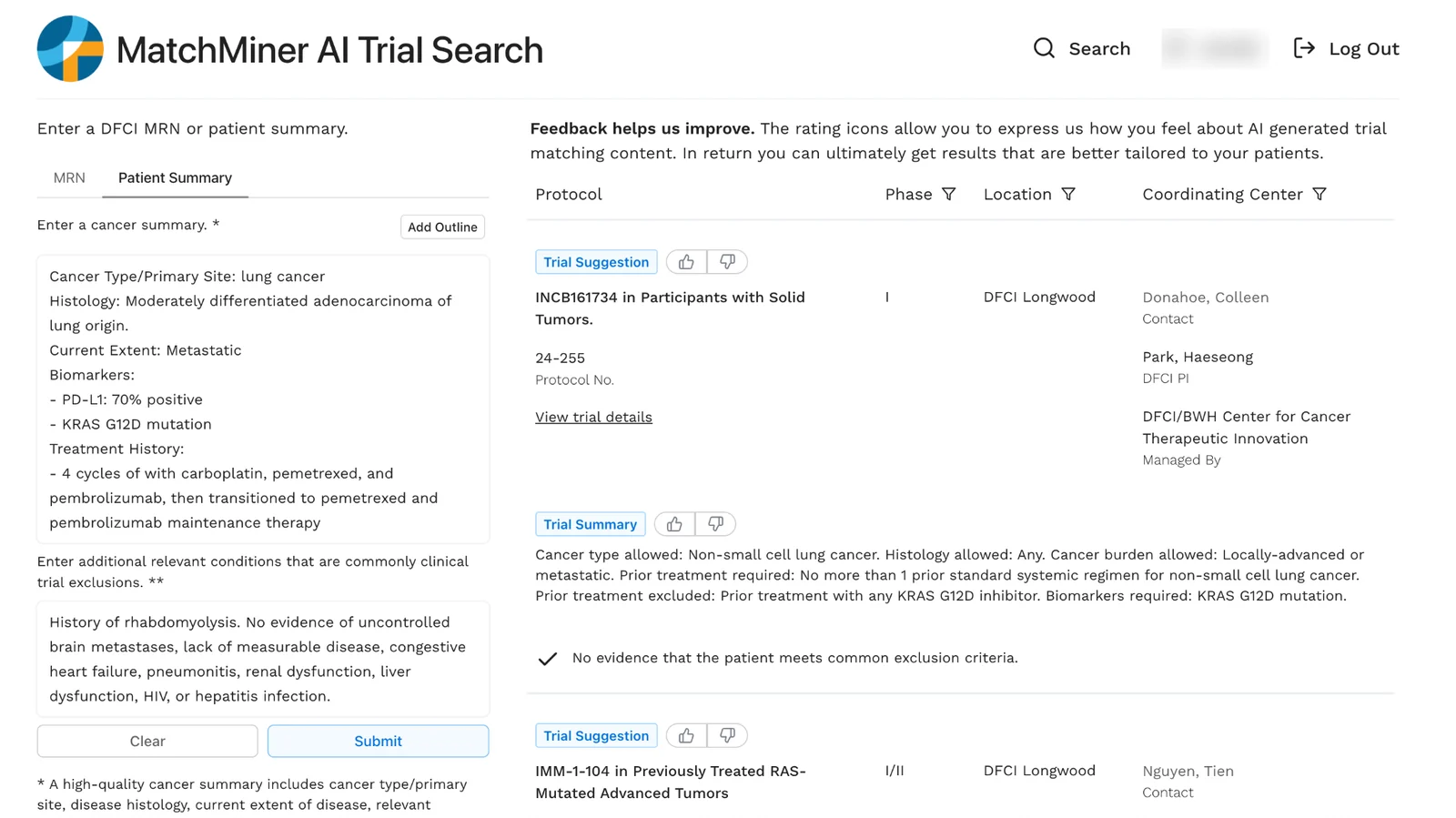
MatchMiner-AI combines an open-source large language model, used with specific prompts and parameters (see the inference pipeline and its documentation), with three families of models the team trained and released:
- TrialSpace finds candidate trials for a patient.
- TrialChecker judges whether the patient meets a trial’s eligibility criteria.
- BoilerplateChecker checks the common exclusion criteria most trials share.
At Dana-Farber
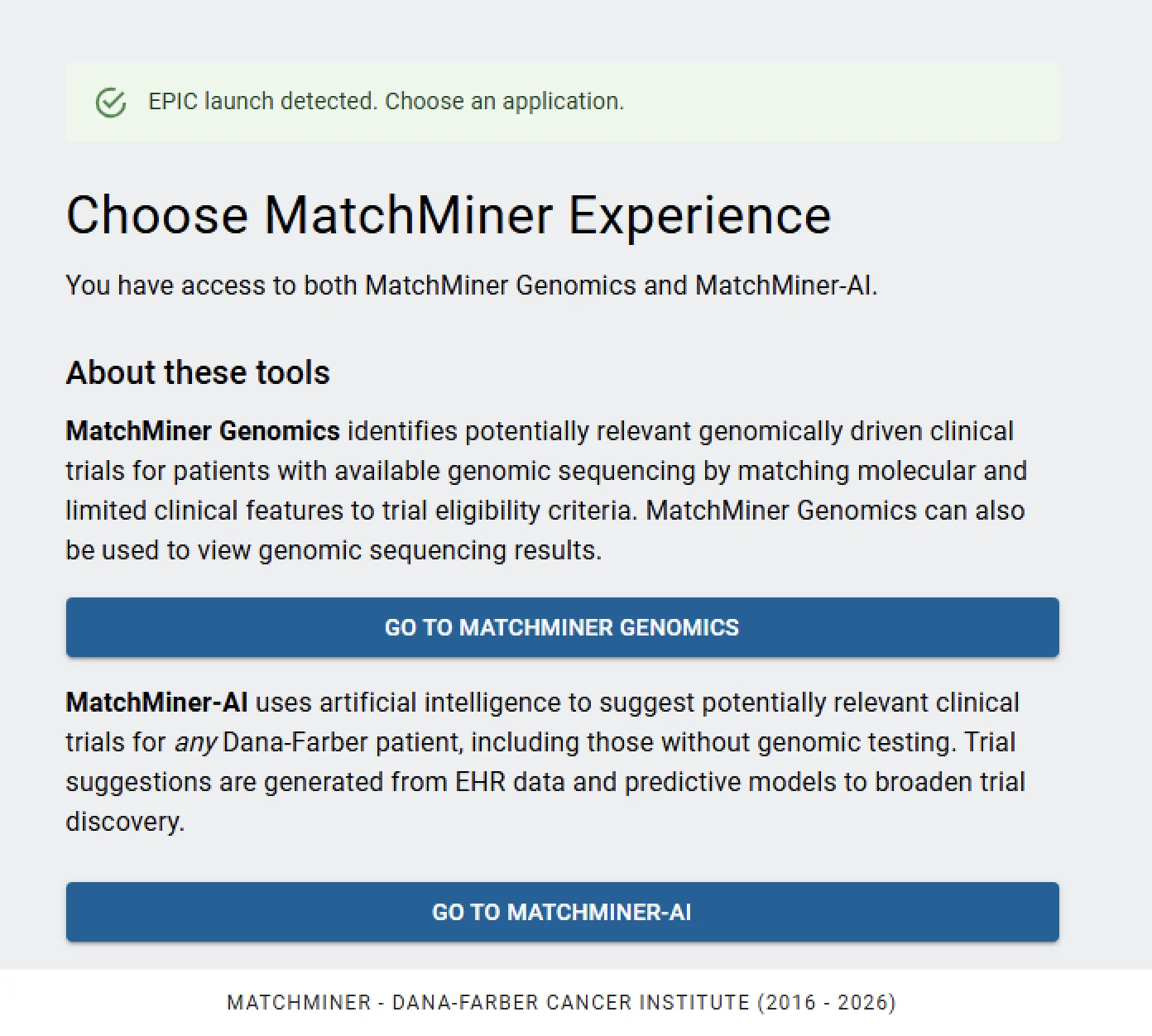
MatchMiner-AI launched for Dana-Farber providers in February 2026. Providers can look up AI-suggested trials for their patients, based on the full medical record. It opens from Epic, alongside MatchMiner Genomics.
It took second place in the 2026 Hearst Health Prize and was selected for the first cohort of Meta’s Llama Impact Grants in 2024.
Randomized studies
In a randomized trial run from 2023 to 2024, AI flagged patients whose cancer was progressing, and their oncologists received emails about trial matches from MatchMiner Genomics. The AI reliably spotted patients likely to need a new treatment, but the emails alone didn’t raise enrollment (JAMA Network Open, 2025). Watch Ken Kehl discuss the study (JAMA Network, on YouTube).
OPTIONS-ACTIVATE, which began recruiting in 2026, is the first randomized study of MatchMiner-AI’s matching. When MatchMiner-AI detects progression, the oncologist gets a ranked list of possible trials based on the patient’s whole record.
Run it at your institution
MatchMiner-AI is free for non-commercial use. Get started covers what it needs: hardware, a language model, trial data, and patient notes.
Read more
Altreuter J. et al., MatchMiner-AI: An Open-Source Solution for Cancer Clinical Trial Matching. arXiv:2412.17228 (2024).